
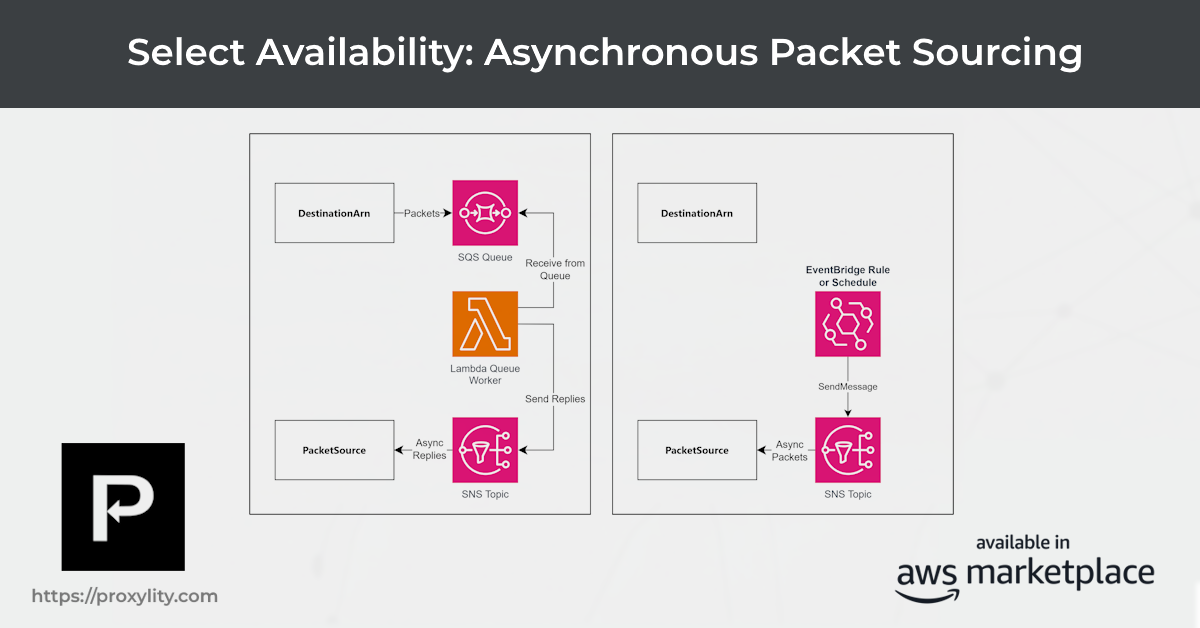
Proxylity UDP Gateway excels at receiving UDP packets from the edge and routing them to serverless backends — Lambda functions, S3, SQS queues, Kinesis streams, and more. That model covers the majority of use cases we've seen, but a class of real-world scenarios needs something more: the ability for an application to originate UDP packets outside of any inbound request and have them delivered to a connected client.
This article explains why that capability matters, what the requirements look like, and how we are building support for it into UDP Gateway.
The Request Path Isn't Always Enough
The existing request path supports two patterns:
- Write-only delivery: Write-only delivery of packet data for processing and archival using services like Kinesis, SQS and DDB that store the information without generating a response.
- Request/Response handling: Request/Response handling of packets where the protocol includes outcome or acknowledgement responses using Lambda or Step Functions.
Since Destinations support multiplexing these patterns can be combined. For example, using a Lambda Destination to generate a response alongside a Firehose Destination for archival.
The limitation of these patterns is that they can only generate egress (outbound) packets during a direct synchronous call to Lambda or Step Functions.
We added support for Lambda Response Streaming, which allows sending more than one response on a timed cadence, but since the Lambda execution must run for the full duration of the response stream it can be expensive and is limited to the maximum Lambda execution time (currently 15 minutes).
For some customers this limitation was a barrier. Some examples:
- Push notifications to IoT sensors
- Sending game state
- Over the Air updates
- Periodic server-initiated pings (availability testing)
- Async responses to work that outlives the original request
- Fan-out from an event to multiple connected peers
We could see the pattern, but the implementation was challenging.
Requirements for Reliable Out-of-Band Packet Sourcing
As background, a Destination receives packets from UDP Gateway as JSON objects containing information
about the source, the destination, the protocol and the payload. In addition, every packet has a unique
Tag property that identifies it.
The packet Tag serves two purposes:
- Tracability of each packet as it traverses the system. This tags allows tracking performance, diagnosing issues, and correlating events across different components.
- Reply routing by identifying the original path taken by the ingress packet, allowing the replies to egress vie the same external IP and port. This is critical for firewall and NAT compatibility.
Packet handlers don't need to use the client IP or port to generate responses. By using the
Tag
responses egress via the Listener's domain/IP and port.
Handlers could theoretically send UDP packets directly, but using the Tag ensures proper
routing and
compliance with network policies. Sending packets to the same client directly would mean the client
would see a different source IP and port, which could cause issues with firewalls and NAT.
Operating with a global footprint adds additional constraints to avoid unnecessary cross-region latency while preserving our flexible global deployment options. It wouldn't be acceptable to source all packets from a single region. Nor would it be acceptable to use different egress endpoints for different regions.
We needed a design that could allow packet sourcing in any region while maintaining consistent egress endpoints and minimizing cross-region latency.
We also needed a design that could scale. Our customer's solutions range from small deployments with a trickle of packets to large-scale deployments with substantial deluges of packets. We didn't want packet sourcing to fall short on that axis of performance either, it needed to handle both ends of the spectrum efficiently and economically.
Oh, and did we mention security? Support for WireGuard Listeners in addition to plain UDP needed to be there from day 1.
We set a high bar. Clearing it wasn't (and perhaps still isn't) a given.
The Design We've Landed On
The primary customer-facing artifact for packet sourcing is an aptly named new regional resource:
PacketSource. For now it's only available as an IaC resource and will be surfaced in the UI
once we reach General Availability.
A PacketSource binds an SNS topic in your account to a UDP Gateway Listener. The Listener
provides the egress endpoint; the SNS topic is how your code sends packets to the Listener.
How and when packets are sent to the SNS topic is up to you, allowing for flexible integration with your existing workflows. And, of course, you have complete control over permission to use the topic via IAM. Your account, your rules.
Unlike the request path, packets sent via a PacketSource don't make use of the
Tag from a request.
Rather, egress packets are sent to the client by IP and port directly. This design choice was motivated
by use cases that aren't triggered by requests at all.
The message to SNS includes the Data field, which contains the payload to be sent, and the
Remote
object which contains the destination IP, port and peer key (when applicable).
Egress packets generated by a PacketSource are billed at the regular packet rate or batch
tiers based on your Subscription.
Here is a minimal CloudFormation snippet showing the customer-side resources. The SNS topic stays in
your account; you register it with Proxylity when creating the PacketSource.
"ReplySource": {
  "Type": "Custom::ProxylityUdpGatewayPacketSource",
  "Properties": {
    "Enabled": true,
    "ListenerName": {
      "Ref": "DecoderListener"
    },
    "SnsTopicSource": {
      "Role": {
        "Fn::GetAtt": [
          "RoleForProxylity",
          "Arn"
        ]
      },
      "TopicArn": {
        "Fn::GetAtt": [
          "ReplyTopic",
          "TopicArn"
        ]
      }
    }
  }
},
Publishing a sourced packet from a Lambda function looks like this:
import boto3, json, base64
sns = boto3.client("sns")
payload = b"\x01\x02\x03\x04"  # your UDP payload
sns.publish(
  TopicArn="arn:aws:sns:us-east-1:123456789012:my-packet-source-topic",
  Message=json.dumps({
    "Data": base64.b64encode(payload).decode(),
    "Remote": {
      "IP": "203.0.113.42",
      "Port": 4567
      # "PeerKey": "<WireGuard public key, if applicable>"
    }
  })
)
Operational Considerations
We only support SNS for now. Likewise packets sources are available via IaC only, and not present in the app
UI. We don't support formatters other than
base64. Access to
PacketSource requires review and approval. But we want your input, so please reach out.
Sourced packet throughput scales automatically — there is no separate rate limit today, though we reserve the right to throttle accounts that send bursts inconsistent with their stated use case during the select availability period.
If the gateway cannot deliver a sourced packet (the remote address is unreachable, the
Remote object is malformed, or other errors) the SNS message is discarded in alignment with the
semantics of UDP. We recommend attaching a
dead-letter queue to your SNS topic to capture and inspect failures. Structured delivery errors are
also emitted to CloudWatch Logs for the Listener, alongside inbound packet events, so a single log
group covers the full picture.
WireGuard Listeners are supported from day one. Set the PeerKey field in
Remote to the WireGuard public key of the target peer; the gateway handles
encapsulation transparently.
We Want Your Feedback
Your feedback is invaluable to us as we work toward General Availability. If you would like to get an early look at the Packet Source feature or provide feedback, please reach out to us by email or LinkedIn.
What's Next?
The PacketSource feature is still under developement. We plan to introduce batched sends, TTL
hints, and an
app user experience prior to General Availability. We also plan to listen carefully to your feedback and
iterate
based on what we hear.