
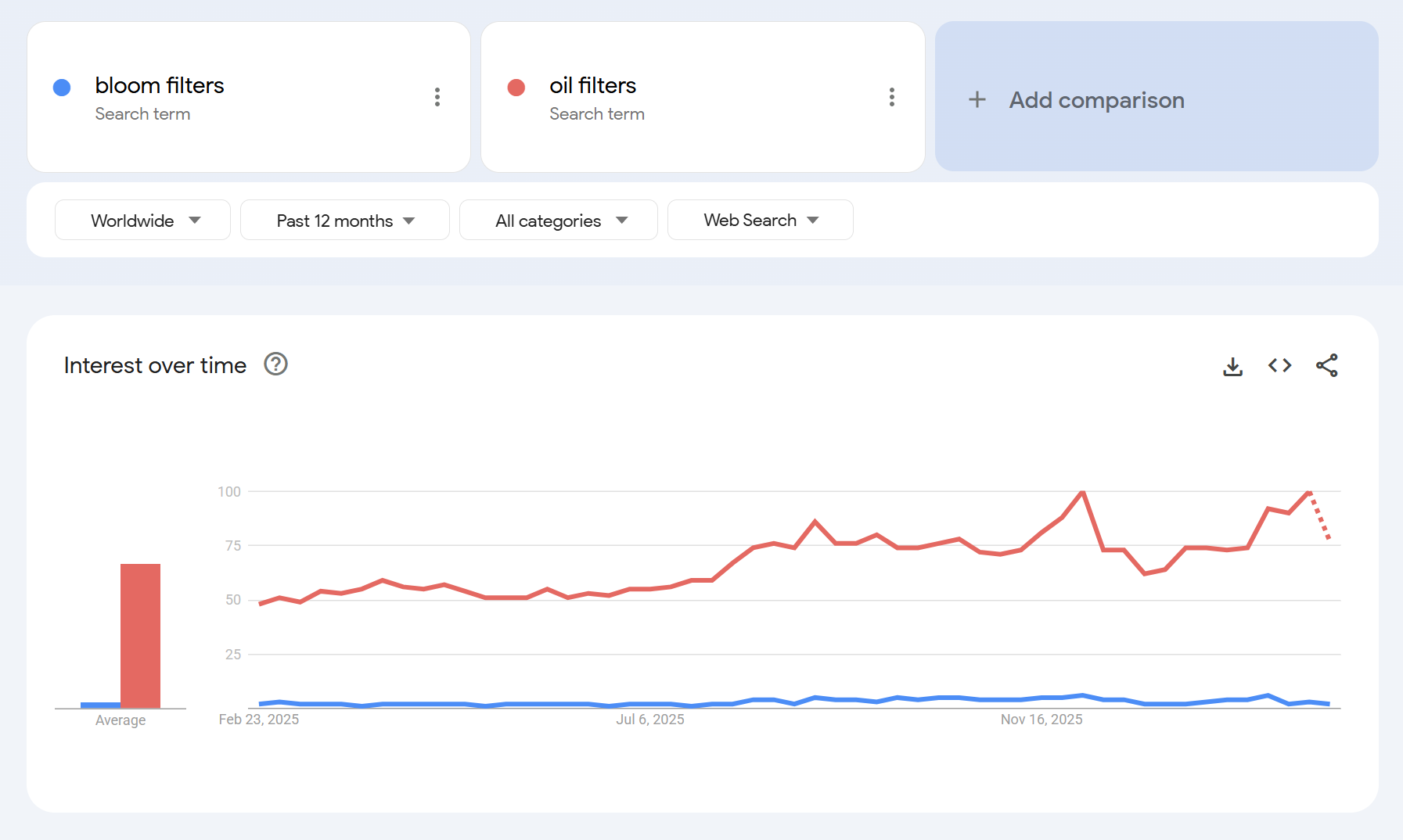
That chart above is a Google Trends comparison of "bloom filters" versus "oil filters."
Oil filters win. It isn't even close.
People, in general, do not care about bloom filters. They do care about keeping their cars running, and that's completely sensible. A bloom filter is a "probabilistic data structure invented in 1970" that can tell you, very fast and very cheaply, whether something is probably in a set or definitely not in a set. It's clever. It's elegant. And the overwhelming majority of humans on Earth will live full and satisfying lives without ever thinking about one.
While we're here: Al vs. AI
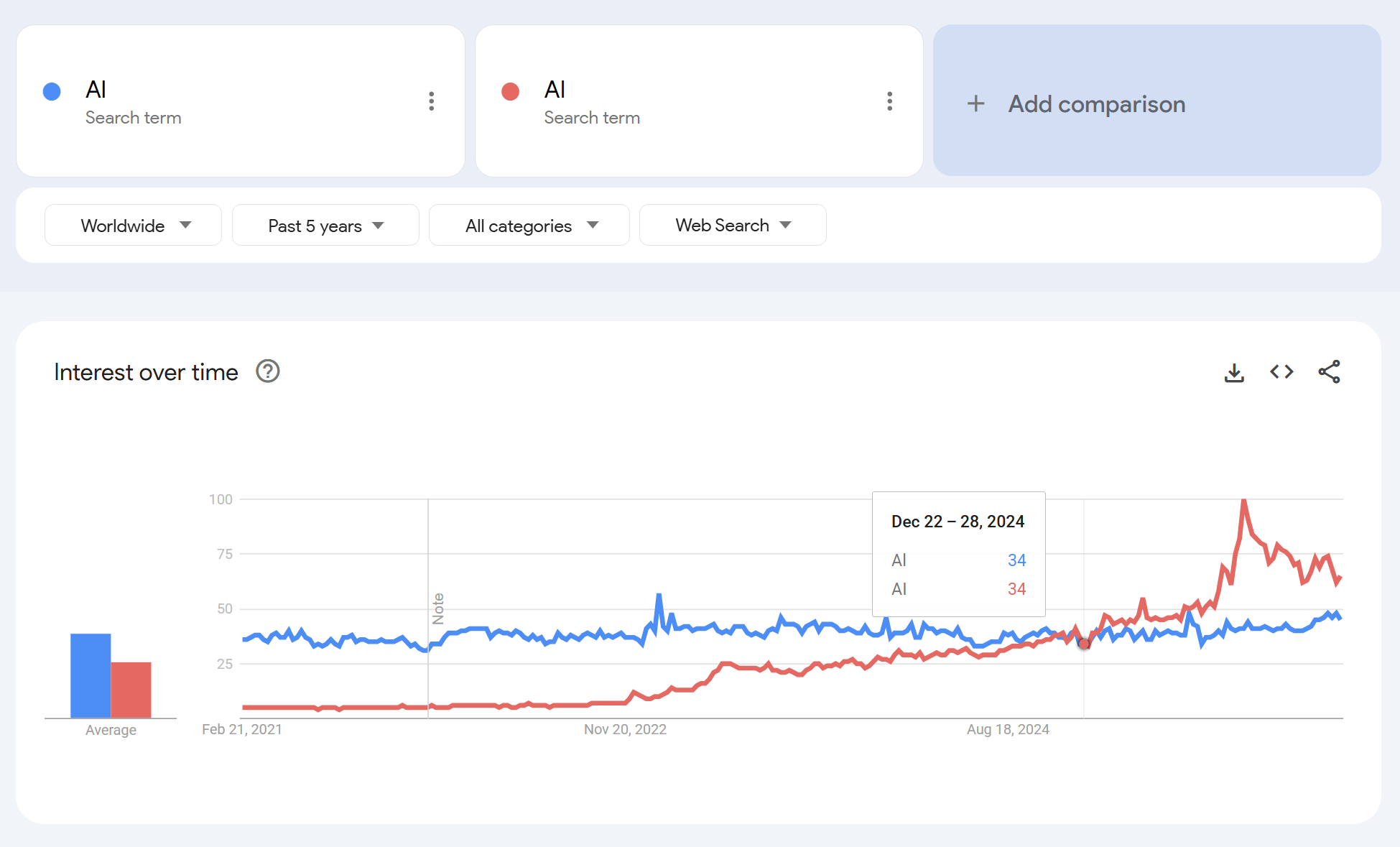
That one is a Google Trends comparison of "AI" and "Al." In many fonts these look identical, which makes the chart confusing at first glance. But more interestingly: search interest in "Al" — as in, a person named Al — was higher and remarkably steady for years, until the end of 2024 when it was overtaken by "AI" the technology.
Al had a good run but he has some work to do to regain his crown.
The things few Google
There is a long list of technical concepts that matter enormously in software but don't generate much search traffic (or public interest). Skip lists. Consistent hashing. Merkle trees. Fowler-Noll-Vo hash functions. These are the kind of things that show up in textbooks, on Hacker News, get implemented once somewhere in a library, and quietly underpin enormous amounts of infrastructure that billions of people depend on daily.
Few people Google "consistent hashing" before streaming a video. The hashing just happens.
The best infrastructure is the kind that works so reliably it becomes invisible.
This is one of the things I find genuinely satisfying about building Proxylity. A lot of what makes UDP Gateway work well isn't visible to the people using it. The scale and reliability features, the deduplication logic, the rate controls — these aren't things customers configure. They're things customers benefit from without thinking about them.
Where bloom filters come in
Proxylity uses bloom filters in Client Restrictions, which let you limit which source addresses are allowed to deliver packets to a Listener. You supply a list of CIDRs, and the Gateway uses that to quickly decide whether an incoming packet should be accepted or dropped before anything else happens.
Bloom filters are a good fit here for a few reasons. Each Listener evaluation happens under tight latency constraints. The working set can be large — potentially thousands of allowed networks. And false positives (letting a packet through when it technically shouldn't) are a tolerable edge case, while false negatives (dropping a packet from an allowed source) are not. The asymmetry maps cleanly onto what bloom filters are actually good at.
You, the customer, don't need to know any of this to use Client Restrictions. You provide a list of networks. Traffic from other networks gets dropped. The bloom filter is just the mechanism that makes it efficient.
Obscurity is not the same as unimportance
The Google Trends charts are funny, but they're also a useful reminder. Search volume is a measure of how much people are actively looking for something — not a measure of how much value it delivers. TCP doesn't trend. TLS doesn't trend. The Linux kernel scheduler doesn't trend. These things are foundational.
The same is true in a narrower sense for UDP-based infrastructure. "UDP" doesn't trend much either. But DNS, NTP, RADIUS, DHCP, syslog, QUIC, VoIP, gaming, and real-time telemetry all depend on it. The protocol is obscure in a public sense, yet the use cases it enables are everywhere.
Building Proxylity is an exercise in working at the obscure layer so that the visible layer can be faster, simpler, and more reliable. There aren't many people Googling "serverless UDP gateway." But the engineers who discover it tend to have a very specific problem that they've been trying to solve for a while, and they're usually quite happy to no longer have to solve it themselves.
Pour one out for oil filters
If you've read this far, you're probably someone who finds satisfaction in the obscure stuff — the data structures, the protocols, the carefully chosen tradeoffs that most people will never notice. That's the audience Proxylity is built for.
Oil filters are important. Bloom filters are important. They're just important to different people in different contexts, in vastly different numbers.
Now, maybe go change your oil. And read about Client Restrictions while you wait.